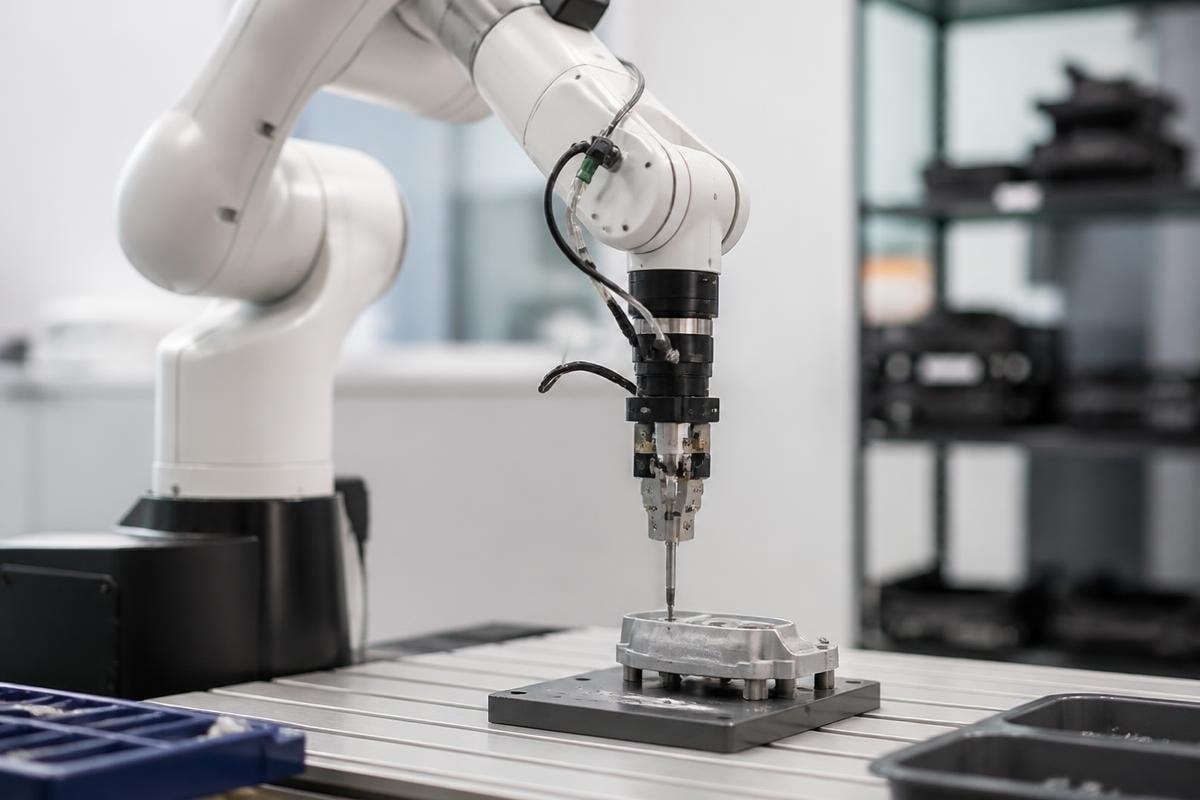
A robot can move an arm to a marked spot long before it can turn a small screw or lift a soft object without damage. Fine motor control starts when the robot links what its sensors detect with the force its motors apply.
For an engineer choosing a robotic arm, the main question is practical: can the system handle small changes in position, shape, grip, and contact?
Quick read
- Cameras estimate an object’s position, shape, and angle.
- Tactile sensors and motor current show when the gripper makes contact.
- Training works best when the robot repeats a narrow task with clear feedback.
What the robot must sense
A camera gives the robot a view of the work area. Computer vision software can find an object, estimate its pose, and send a target position to the arm. Pose means the object’s location and rotation in space.
That view has limits. A camera may miss a thin edge, lose sight of an object behind the gripper, or misread a shiny surface. The robot needs another signal when the fingers touch the object, so many systems read force, torque, or motor current.
Motor current is useful because a motor needs more current when it meets resistance. It isn't a direct measurement of grip force, so the robot still needs calibration and careful limits. A small error can crush a soft part or let a heavy one slip.
How training works
Most fine motor tasks start with demonstrations or programmed movements. A person may guide the arm through a motion, or an engineer may write target positions for each joint. The robot records the joint angles, timing, sensor readings, and the result.
That record becomes a starting point for a control policy. A policy is software that chooses the next movement from the sensor data. It may tell the gripper to close, pause, rotate, or reduce force after contact.
Reinforcement learning adds a score to each attempt. The robot receives a higher score for placing a part correctly and a lower score for dropping it, using too much force, or taking too long. Repeated trials change the policy so the better movements occur more often.
Simulation can supply many of those trials without wearing out a real arm. The hard part comes when the trained policy moves to hardware.
A simulator may get the object weight, surface grip, motor response, or camera view slightly wrong, and small errors can change the result.
Why contact changes the task
A free-space movement has no contact with the work surface. The arm can
follow a planned path and check its position as it moves. Once the gripper touches an object, the task becomes less predictable.
The robot must adjust its motion from new sensor data. It may close the fingers until force reaches a safe range, move along an edge, or rotate the object until the grip becomes stable. This feedback loop is called force control when the system changes movement to meet a target force.
Fine control also depends on the object. A rigid bolt needs a different grip from a foam pad. A loose fit may require the robot to search for the right angle instead of repeating one fixed path. That is why a motion that works on one part can fail on another part from the same tray.
Fine motor learning only matters when a robot repeats a task after contact changes. Robot motor learning reports can tie that claim to a named machine, test, and result before the next section examines where learning still fails.
Where learning still fails
Training data can describe the objects and conditions the robot has already seen. It cannot cover every wrinkle, change in lighting, worn gripper pad, or object placed a few millimeters away from its expected position.
The system can also learn the wrong shortcut. If a camera angle makes one side of a part easy to see, the policy may rely on that view instead of learning a reliable grasp. Engineers need tests that change the lighting, object position, and surface condition.
Safety adds another limit. A system must stop when force rises too quickly, a person enters the work area, or a sensor gives conflicting readings. More training does not remove the need for physical guards, stop controls, and limits in the arm software.
I’d trust a fine-motor system only after it handles changed object positions and contact forces, not just a clean set of recorded demonstrations.
A practical check before you buy
Use this list when you compare a research platform with a production arm:
- Name the task: write the exact part, grip, motion, and required result.
- Check the sensors: confirm whether the arm reads force, torque, motor current, touch, or only camera data.
- Ask for failure tests: request results with changed lighting, object positions, and worn contact surfaces.
- Measure recovery: see whether the robot pauses and tries again after a slip or failed grasp.
- Set safety limits: confirm stop controls, force limits, guarded zones, and manual recovery steps.
- Price the training work: include data collection, simulation, calibration, gripper changes, and staff time.
A fixed pick-and-place motion may need little learning at all. The harder target is a system that senses contact, changes its grip, and keeps working when the part is not where the training run placed it. That remains the test that separates a useful fine-motor system from a polished demo.